RLS Technical Series #6: Eviota guttata is more complex than you'd think

Eviota guttata observations in the Reef Life Survey database have had a makeover, reflecting recently described species within what we now know to be the E. guttata complex. So, how complex is the process of telling these pygmygobies apart?
By RLS Support Officer Joanna Schmid
May 06, 2026
Share this post to:

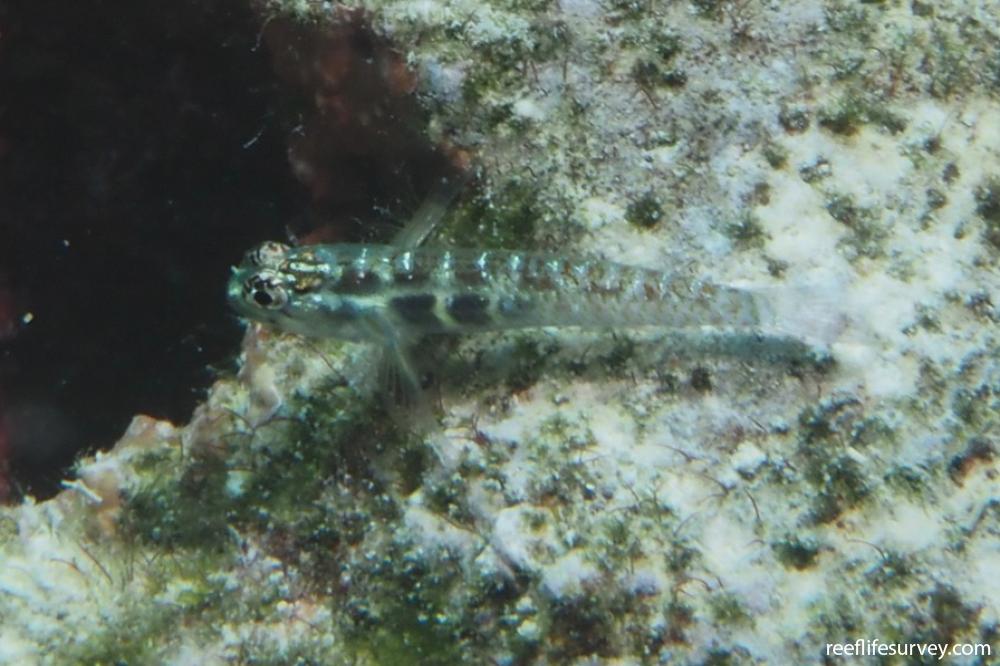
You may be familiar with Eviota guttata; a species of pygmygoby which has been recorded by RLS divers around 3000 times. This tiny goby presents with a cluster of red blotches atop its head, and alternating red and yellow to white bands on its flanks. Well if only it was that simple! In 2023, Erdmann, Greenfield, and Tornabene (veritable goby experts) shed some much needed light on what we now know to be an entire complex of related species of Eviota, each (so far) with unique presentations of the markings listed above. While some members of the complex were previously described, descriptions of their colour in life were often not available, making it extremely difficult to positively identify these species in the field. Now with renewed knowledge, we can begin to confidently differentiate this cohort of closely related but geographically non-overlapping species both in the field and in Reef Life Survey's historical data.


Although there are still likely many more species in this complex yet to be described, here is what we know so far, starting with the fish of the hour: 

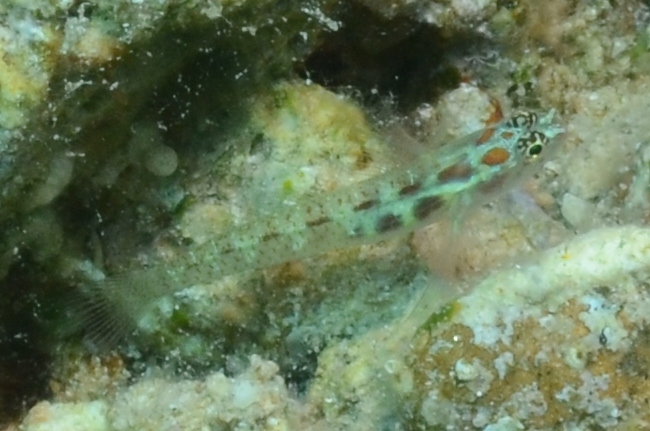
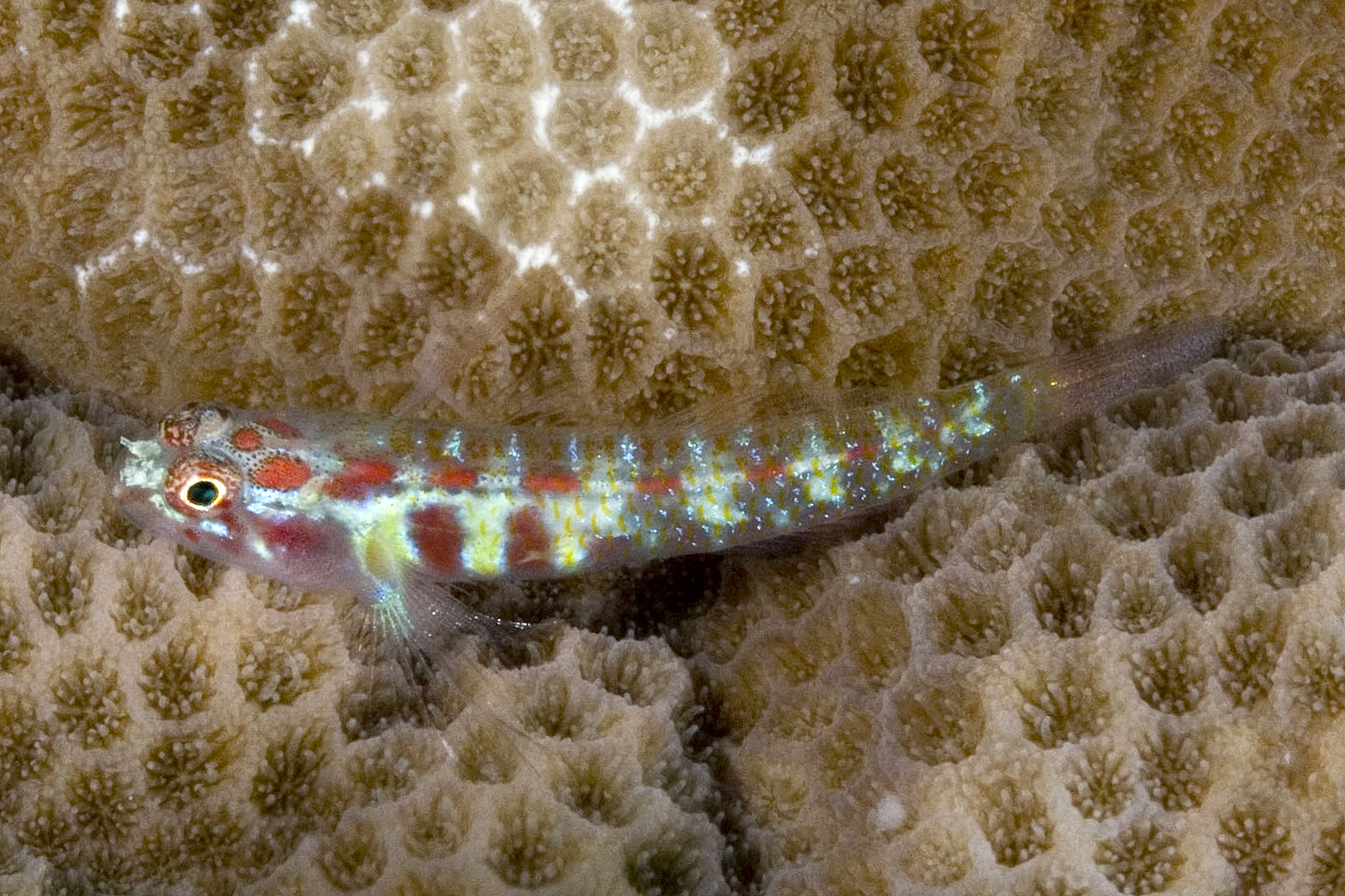
Eviota guttata 

  1. First described from specimens in the Red Sea, E. guttata currently has confirmed observations in the Red Sea and the Gulf of Oman  
  2. Head spots are each distinctly separate from one another. One is interorbital (between and behind the eyes, on the midline), and the remaining two are behind each eye
  3. Eyes with thin white or gold spokes extending out from the pupil, occasionally with mottling over the iris
  4. Red stripe behind eye incomplete  
  5. Red blocks on side of body are wider than they are tall  

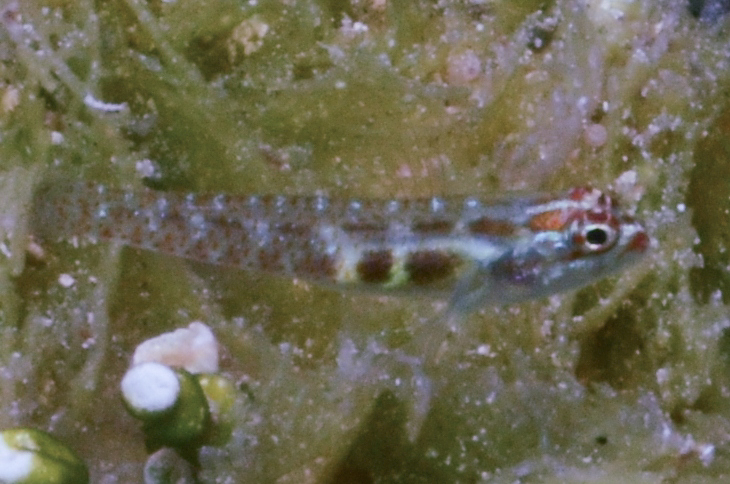
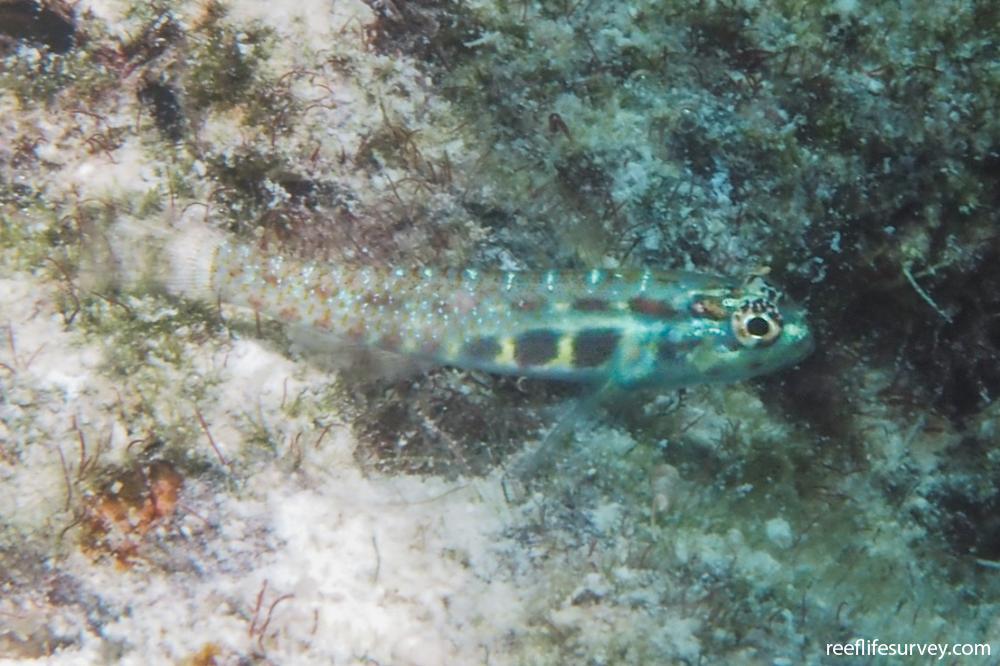
Eviota teresae 

  1. Known to occur in Fiji, and individuals within the coral triangle closely resembling this species are yet to be genetically verified
  2. Out of all of the 'Eviota guttata' photos in our archive, almost all fit the morpholigical description of E. teresae, leading us to tentatitvely believe this to be the more widespread of the complex
  3. Like E. guttata, head spots are each distinctly separate from one another. One is interorbital (between and behind the eyes, on the midline), and the remaining two are behind each eye
  4. Eyes with a gold ring around the pupil, and no prominent spokes
  5. Red stripe behind eye incomplete  
  6. Red bars on side of body are roughly triangular, being roughly two times wider at the top than the bottom 
  7. White/ yellow bars wider than pupil diameter 
Eviota guttata, Red Sea. Photo by Graham Edgar

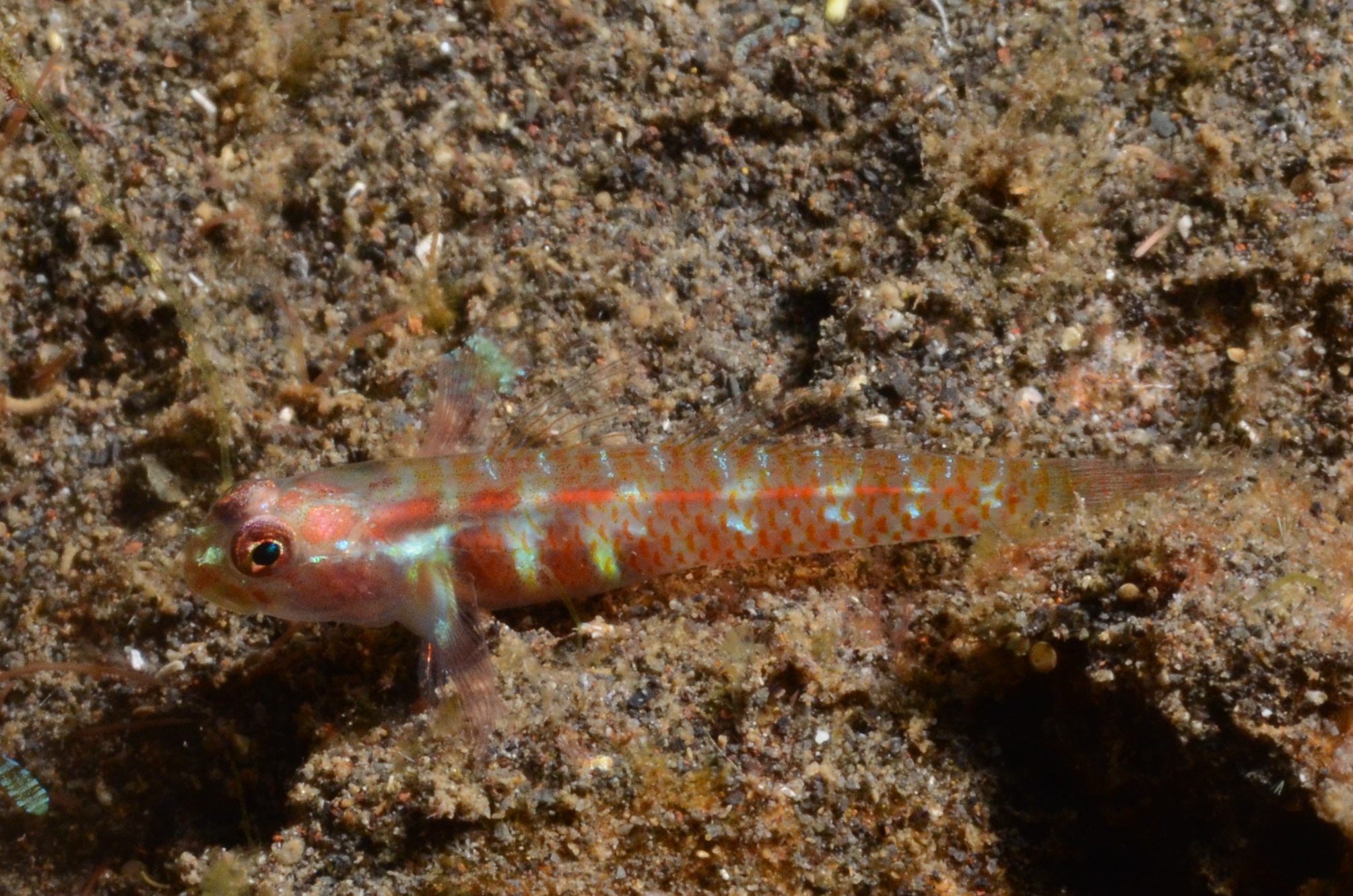
Eviota taeiae 

  1. Known to occur in Samoa, but likely more widespread
  2. Originally described from Nuusafee Island, Samoa in 2023, and recently recorded by RLS divers in Samoa and Wallis and Fortuna
  3. Head spots are connected to eachother, rather than separate as in E. guttata and E. teresae
  4. Eyes with multiple thin white or gold spokes radiating out from the pupil, occasionally with mottling over the iris (like E. guttata)
  5. Red stripe extending behind each eye is partially complete, whereas is incomplete in E. guttata and E. teresae
  6. Red bars on side of body are taller than they are wide
  7. White/ yellow bars are narrower than pupil diameter 

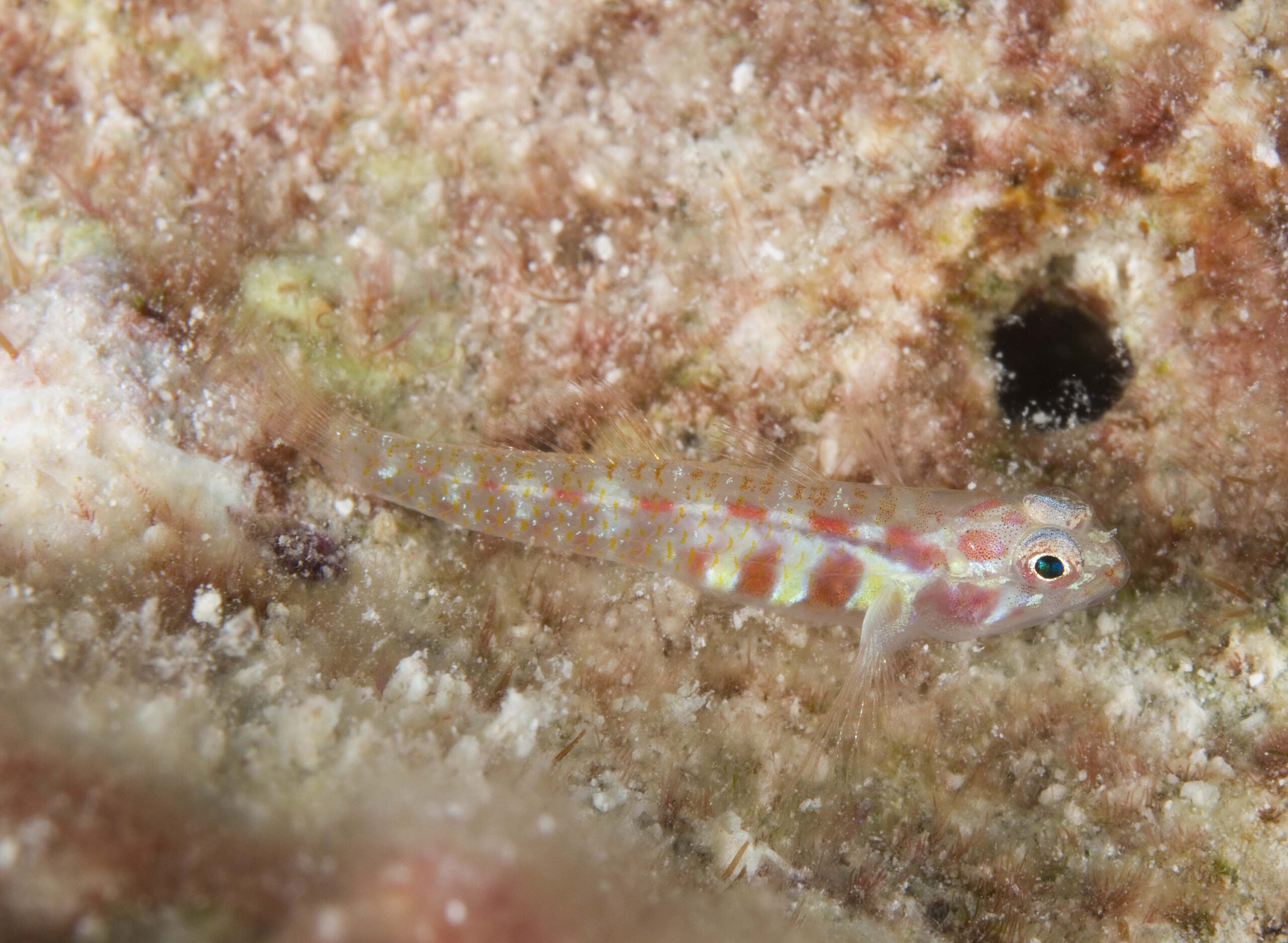
Eviota albolineata 

  1. Known to occur in the Society Islands and Tuamotus, French Polynesia. Thought to be restricted to these locations, however based on specimens photographed further east (e.g. Cook Islands), RLS have more wide-ranging records of this species (not genetically confirmed) 
  2. Lacking interorbital red spot which is present in all other species within the complex
  3. Eyes with four wide white or gold spokes extending out from pupil, with no mottling on iris 
  4. Red stripe behind eye is partly connected to the two large red spots behind the eyes 
  5. Rectangular red bars are relatively narrow compared to sister species E. taeiae
  6. White/ yellow bars are relatively narrow compared to E. teresae
Eviota albolineata, Cook Islands. Photo by Graham Edgar
While we now have a clearer idea of some of the members of this species complex and where to find them, Erdmann, Greenfield and Tornabene theorise that their work has only just begun. Different colour variations are seen in locations throughout the Pacific, hinting that there may be additional species within the complex that are not yet described. And indeed, observations that Reef Life Survey are now assigning to E. teresae based on our archival photos taken during surveys are not certain records, as the occurrence of this species has not yet been genetically verified outside of Fiji. With that said, the authors similarly note that photographs of specimens throughout the Coral Triangle closely resemble those from Fiji.  

There are likely more updates to this species complex on the horizon, and we encourage Reef Life Survey divers to brush up on the differences between these species and to take lots of photos! We are available to help you with identification of these trickier species, so don't hesitate to send photos through to [email protected]. You can find a more extensive photo library and full descriptions in this paper

Literature cited: 

Erdmann, MV, Greenfield, DW & Tornabene, L 2023, Eviota taeiae, a new dwarfgoby (Teleostei: Gobiidae) of the Eviota guttata complex from Samoa, Journal of the Ocean Science Foundation, vol. 40.  

Greenfield, DW 2021, Four new fishes of the genus Eviota from the Western Pacific, with clarification of Eviota guttata and Eviota albolineata (Telestei: Gobiidae), Proceedings of the California Academy of Sciences, vol. 61, no. 3, pp. 269-2889. 


More photos

Share this post to:

STAY IN TOUCH

Subscribe to the RLS Newsletter to stay up to date on the latest RLS news, field activities & research.
Subscribe to Newsletter
Supported by The Ian Potter Foundation
The Minderoo Foundation
Website Design by Forte Web Design
website design by Forte Web Design
linkedin facebook pinterest youtube rss twitter instagram facebook-blank rss-blank linkedin-blank pinterest youtube twitter instagram